Belly: Virtual Pet on your Apple Watch
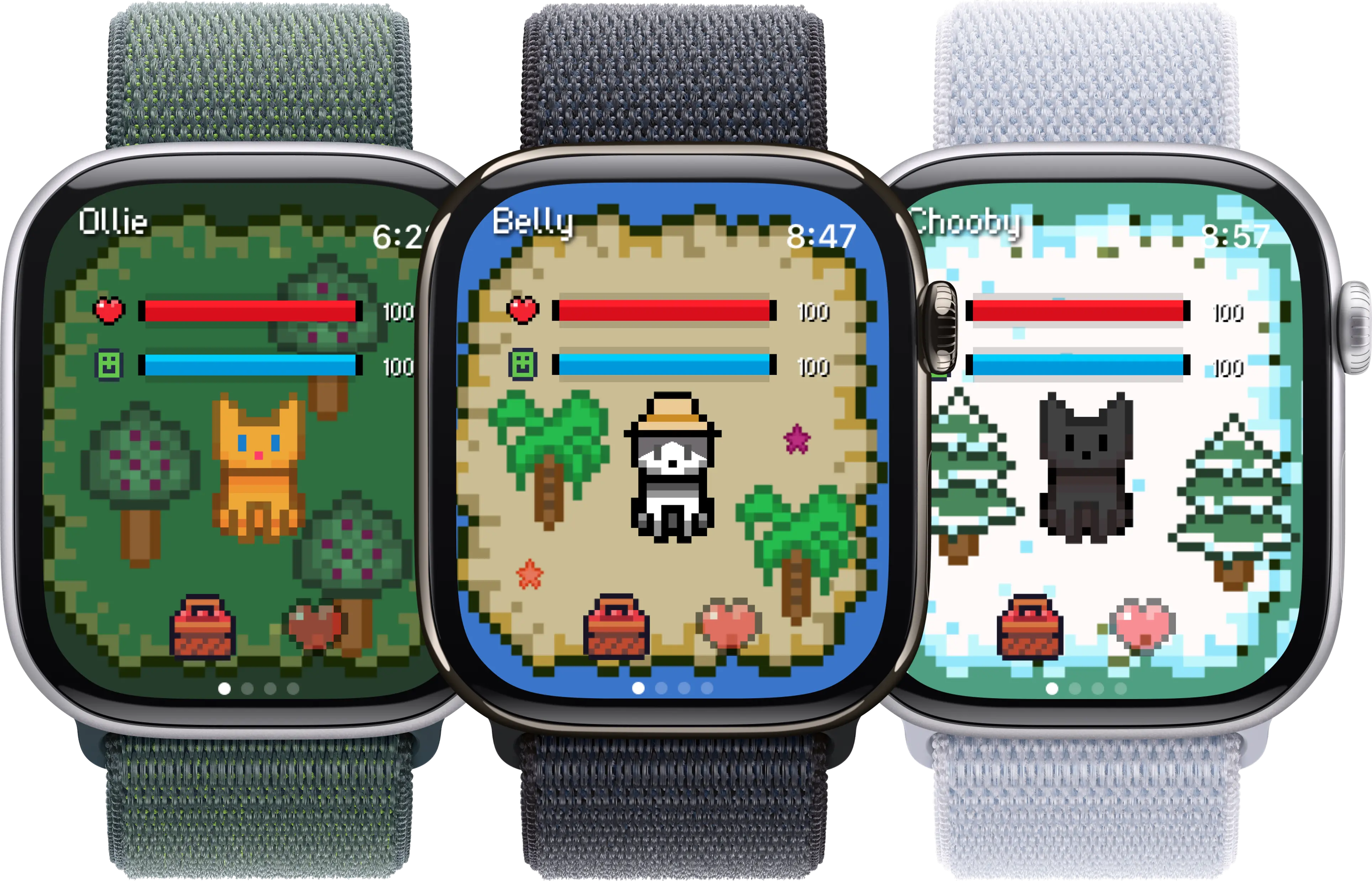
A virtual pet for your Apple Watch. Today it has ~7K daily users.
Why
The true origin story is that I got a cat and I wanted to have a virtual version of her to put on my Apple Watch. This then led me to think about virtual pets.
There were plenty of Reddit threads asking for an Apple Watch Tamagotchi, but the existing options were all some combination of ugly graphics (shockingly bad), paywalled, or abandoned. I wanted something cute, well-maintained, and most importantly, had my cat in it (yes...). Unlike my first app, this time I was building for a problem I actually had, and one that other people were clearly already asking about.
I chose to build it as a standalone watchOS app. A Tamagotchi works because it's small and always on you, and a watch is the closest thing to that today. That choice is a big part of why it feels right, and also why it's capped. The small screen limits what features I can add, and watchOS is just less powerful than iOS. If I had to do this again, I would probably support iOS from the get go with the watch as a companion. That way, I get to benefit from iOS app store visibility/discovery, have more real estate on a phone screen to play with, and avoid watch connectivity issues (bane of my existence).
What I learned
- AI is more powerful than you imagine. The first live version of the app was written completely with Sonnet 3.5 and Sonnet 3.7 via Cursor. While building 'real' apps entirely with AI wasn't novel then in mid-2025, the concept only really reached a wider audience with Opus 4.x when model capabilities advanced significantly. My point is that we don't need to keep thinking that AI models aren't powerful or good enough to do what we want perfectly - (almost) nothing, that an average person can think of, is out of reach. What matters is our ambition and drive to use AI to see things through, and make things work.
- Know the limits of AI (Note: this is slightly outdated with latest Opus/Fable models but leaving here as a reminder of what I felt when I wrote this in 2025). While AI could churn out a ton of code, there were bugs that just could not be resolved no matter how hard I prompted. With the Sonnet models, I found that diagnosis and direction were often times the bottleneck and I had to do manual research to prompt the agent to debug in a certain direction. This doesn't contradict my first point - once we understand the limits of AI, it remains our job to find ways to 'unblock' AI to get it to learn, and then make things work.
- Stay close to your users. Support emails reveal bugs I'd never think to test for, what people are frustrated with or get stuck at, or on the flip side, why they love the app (from which I understand better what to build), and what they would like to see.
- Distribution remains the bottleneck, and it's my weakest skill. AI made building the easy part, but getting found is still hard. I didn't do much distribution myself (tried US TikTok for a few days but just didn't have the discipline/interest/aptitude to create content) and ended up getting lucky with Chinese users somehow finding my app. I went with the lazier, lower effort SEO path, but the real way to grow my user base is to really commit to short-form video content. I still won't do it though lol.